Zone: 3 to 9
Soil: Sand to loam
Light: Full sun to part sun
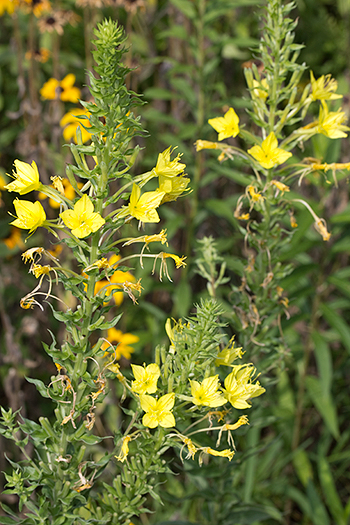
Bloom colour: Yellow
Bloom period: late spring to early summer
Height: 2 to 6 feet
Moisture: Dry to medium
Attracts: Bees and sphinx moths.
Notes: This genus is divided into sundrops and evening primroses. Sundrops tend to be more compact and flower during the day. They have open flowers suitable for a range of diurnal pollinators. In order to compete with other plants for the attention of pollinators, they produce large amounts of nectar over a shorter time period.
Evening primroses have evolved a different strategy involving a greater degree of specialisation. The corolla is deeper which limits pollination to long-tongued insects. They open late in the afternoon and are pollinated by sphinx moths. Only some of the flowers are open on any particular night, but they have much longer blooming periods.
If one only considers aesthetics, sundrops, with their limited stature and heavy blooms, are better plants for a small garden. But evening primroses bring in the moths. Common evening primrose is a biennial and it is not easy to place because it is tall and lanky. You have to accept that it may not be in flower during the day when you are looking at it. If you do plant it, put it behind other plants with the flowers peaking through at the top. Evening primrose is very easy to grow and maybe too easy because it can self pollinate. This is a great survival strategy in areas where moths are low in number.
As an alternative to O. biennis, consider planting O. rhombipetala, sand evening primrose. This plant is similar in terms of ecological relationships, but this plant is shorter and the flowerhead, which is a dense terminal spike seems well proportioned to the rest of the plant. It is simply easier to integrate this species into a mixed border. Unfortunately, it is biennial, monocarpic and does not self-pollinate, but at least it flowers for most of the summer. You cannot grow this plant in pots for the first year because the taproots can grow more than 2 feet into the ground. Transplant seedlings into the bed as soon as convenient. This plant is native to sandy soils around Lake Michigan so it is not native to Ontario.
Better plants for a garden include Oenothera pilosella and Oenothera fruticosa. These plants are particularly showy and I use them as accent plants. As they are only in flower for a few weeks, they are not the mainstay of the garden. Prairie sundrops grows particularly well in sandy soil. Unlike common evening primrose, it is perennial and you do not need a plan to keep replacing it. |